Acetylation dynamics of MrATG4 governing autophagy-mediated conidiation in an entomopathogenic fungus
Deshui Yu1,2, Yulong Wang1, Rui Xie1, Rong Zhou1,3, Zhenbang Liu4, Najie Shi1, Xiangyun Xie1,5, Yang Yang1, Jiaojiao Qu1, Guang Yang1,6*, Bo Huang 1*
1 Anhui Provincial Key Laboratory of Microbial Pest Control, Anhui Agricultural University, Hefei, China,
2 Hefei City Forestry Protection Center, Hefei, China,
3 Sericulture Research Institute, Anhui Academy of Agricultural Sciences, Hefei, China,
4 School of Life Sciences, University of Science and Technology of China, Hefei, China,
5 College of Agriculture and Biology, Liaocheng University, Liaocheng, China,
6 Biomass Molecular Engineering Center and Department of Materials Science and Engineering, Anhui Agricultural University, Hefei, Anhui, China
These authors contributed equally to this work.
* bhuang@ahau.edu.cn (BH); guangyang@ahau.edu.cn (GY)
OPEN ACCESS
Citation: Yu D, Wang Y, Xie R, Zhou R, Liu Z, Shi N, et al. (2026) Acetylation dynamics of MrATG4 governing autophagy-mediated conidiation in an entomopathogenic fungus.
PLoS Pathog 22(1): e1013883. https://doi.org/10.1371/journal.ppat.1013883
Editor: Chengshu Wang, Chinese Academy of Sciences, CHINA
Received: June 27, 2025
Accepted: January 9, 2026
Published: January 20, 2026
Copyright: © 2026 Yu et al. This is an open access article distributed under the terms of the Creative Commons Attribution License, which permits unrestricted use, distribution, and reproduction in any medium, provided the original author and source are credited.
Data availability statement: All relevant data are within the manuscript and its Supporting information files.
Funding: This work was supported by grants from the National Natural Science Foundation of China (No. 31972332 to B.H.; 32102274 to Y.W.). The funders had no role in study design data collection and analysis, decision to publish, or preparation of the manuscript.
Competing interests: The authors have declared that no competing interests exist.
Abstract
Conidial production is a critical factor determining the efficacy of entomopathogenic fungi as biocontrol agents. Autophagy, a fundamental cellular degradation process, plays an essential role in regulating fungal conidiation. However, the modulation of autophagy through acetylation, particularly concerning the autophagy-related protein ATG4, remains poorly understood in fungi. Here, we investigate the roles of the deacetylase MrSIR2–3 and the acetyltransferase MrKAT1 in Metarhizium robertsii, focusing on their impacts on autophagy and conidiation. Our findings demonstrate that deletion of MrSIR2–3 (ΔMrsir2–3) leads to elevated autophagy levels, whereas loss of MrKAT1 (ΔMrkat1) suppresses autophagy initiation; both alterations consequently impair conidiation. Interaction assays further reveal that the key autophagy factor MrATG4 is regulated by opposing acetylation and deacetylation mediated by MrKAT1 and MrSIR2–3, potentially via modification of lysine residues K69 and/ or K77. This dynamic acetylation balance is essential for maintaining autophagy homeostasis and ensuring efficient conidiation. Collectively, our results provide novel insights into how the acetylation of ATG4 modulates autophagy, advancing our understanding of conidiation regulation in entomopathogenic fungi and highlighting potential targets for enhancing fungal biocontrol efficacy.
Author summary
Autophagy is a vital cellular process that supports growth and reproduction in fungi by forming autophagosomes to digest and recycle cellular components. In PLOS Pathogens | https://doi.org/10.1371/journal.ppat.1013883 January 20, 2026 2 / 19 this study, we explore the role of the autophagy-related protein MrATG4 in the autophagy and conidiation of the entomopathogenic fungus Metarhizium robertsii, a widely used biopesticide for natural pest control. We focus on the regulatory roles of MrSIR2–3, a deacetylase, and MrKAT1, an acetyltransferase, in modulating the acetylation status of MrATG4. Our findings reveal that deletion of MrSIR2–3 enhances autophagy, whereas deletion of MrKAT1 suppresses it, both significantly impacting conidia production. This study provides the first evidence that acetylation of ATG4 is crucial for autophagy and conidia formation in fungi. These insights deepen our understanding of fungal growth and reproductive regulation and offer potential strategies for optimizing biological pest control.
Introduction
Autophagy is a highly conserved cellular degradation pathway essential for maintaining cellular homeostasis by facilitating the turnover and reutilization of proteins and organelles, particularly under stress conditions such as nutrient starvation or pathogen infection [1,2]. This process involves the formation of autophagosomes that sequester cytoplasmic content and deliver it to the lysosomal compartment for degradation [3]. In filamentous fungi, autophagy is pivotal for various aspects of fungal biology, including growth, differentiation, conidiation, and pathogenesis [4–6].
The molecular underpinnings of autophagy have been extensively elucidated through the study of autophagy-related (ATG) genes, beginning with the identification of ATG1 in Saccharomyces cerevisiae [3,7]. Metarhizium robertsii serves as both an entomopathogenic fungus and a plant symbiont, with at least ten Mratg genes playing essential roles in nutrient utilization, underscoring the critical importance of autophagy [4,8–11]. Among these, ATG4, a cysteine protease, is indispensable for the processing of ATG8, a ubiquitin-like protein essential for autophagosome formation and autophagic flux [3,8]. Functional studies in fungi such as Magnaporthe oryzae and Aspergillus oryzae have demonstrated that ATG4 deletion results in defects in both autophagy and conidiation, underscoring its vital role in fungal development and virulence [5,6].
The regulation of autophagy is intricately controlled by post-translational modifications (PTMs) of ATG proteins, with acetylation emerging as a critical PTM influencing this process [2,12–15]. Acetylation modulates the activity, stability, and interactions of key autophagy regulators, thereby fine-tuning autophagic responses [14]. Acetyltransferases, such as CBP, P300, and TIP60, and deacetylases, including HDAC6 and the NAD ⁺ -dependent deacetylase SIRT1, have been extensively characterized for their roles in autophagy regulation [14]. For example, acetylation of key autophagy factors such as ATG5, ATG7, ATG8, and ATG12 by P300 promotes autophagy, while deacetylation by SIRT1 directly regulates these proteins to modulate autophagic activity [16,17].
Recent studies in mammalian systems have identified acetylation of ATG4B as a pivotal mechanism regulating the initiation of autophagy during starvation. This acetylation-dependent modulation of ATG4B activity underscores the conserved role of acetylation in autophagy regulation across eukaryotes [18]. However, the role of ATG4 acetylation in fungi remains unexplored, presenting a significant gap in our understanding of autophagy regulation in these organisms.
In fungal systems, acetylation of ATG-like genes is essential for maintaining autophagy homeostasis, which in turn influences fungal growth, conidiation, and virulence. For instance, in Magnaporthe oryzae, the acetyltransferase Gcn5 acetylates ATG7, thereby affecting starvation-induced autophagy and phototropism [19]. Similarly, in Fusarium graminearum, Gcn5-mediated acetylation of ATG8 induces autophagy, impacting fungal growth, competitive fitness, and virulence [20]. Additionally, in F. oxysporum, the deacetylation of FolGsk3K271 by the deacetylase FolSIR2 modulates fungal pathogenicity [21].
Despite these advancements, the acetylation of ATG4 and its regulatory implications in fungal autophagy remain unexplored. Given the central role of ATG4 in autophagosome formation and autophagic flux [1,2], understanding its regulation through acetylation could unveil novel mechanisms critical for autophagy-mediated processes such as conidiation and pathogenicity. Elucidating the acetylation dynamics of ATG4 in entomopathogenic fungi like M. robertsii is particularly pertinent [22–26], as efficient conidial production is a bottleneck in the practical application of fungi-based biopesticides, fertilizers, and plant immunity promoters [9,11].
This study aimed to investigate the acetylation regulation of MrATG4 by the deacetylase MrSIR2–3 and the acetyltransferase MrKAT1 in M. robertsii. By systematically analyzing mutants of the SIR2 family and identifying the specific lysine residues targeted for acetylation, we seek to elucidate the molecular mechanisms by which acetylation modulates autophagy and conidiation. Our findings provide novel insights into the post-translational regulation of autophagy in entomopathogenic fungi, offering potential targets for enhancing fungal biocontrol efficacy.
Results
Bioinformatic analysis and subcellular localization of SIR2s homologs
To investigate the role of lysine acetylation (Kac) in fungal development, we initially examined mycelial growth and the early stages of conidiation in M. robertsii. Western blot analysis revealed a significant increase in global Kac levels during initial conidiation compared to mycelial growth, with prominent bands observed between 25–35 kDa, which suggests that acetylation plays a regulatory role in conidiation (Fig 1A).
The SIR2 family, recognized as NAD + -dependent deacetylases, is widely reported to be involved in various biological processes. However, its role in entomopathogenic fungi remains poorly understood. Orthologs of the four SIR2 proteins (HST1, HST2, HST3, HST4) from S. cerevisiae were identified in the M. robertsii genome: MrSIR2–1 (MAA_02098), MrSIR2–2 (MAA_01056), MrSIR2–3 (MAA_02065), and MrSIR2–4 (MAA_04246) (Fig 1B). Domain architecture analysis confirmed the presence of NAD + -dependent protein/histone deacetylation domains within these homologs. Phylogenetic analysis further demonstrated that all MrSIR2s are highly conserved and cluster within the four subfamilies corresponding to HST1–4, respectively (Fig 1C).
Transcriptomic analysis via RNA-seq across different developmental stages—conidia (0 d), initial mycelial growth (1.5 d), initiation of conidiation (2.5 d), and conidial maturation (5 d)—revealed that Mrsir2–3 exhibits significantly higher expression levels compared to other Mrsir2s during mycelial growth and conidiation (Fig 1D).
Subcellular localization analysis using GFP fusion constructs and DAPI staining revealed distinct subcellular distributions of the MrSIR2 proteins (Fig 1E). Specifically, MrSIR2–1-GFP and MrSIR2–4-GFP were predominantly localized to the nucleus, whereas MrSIR2–2-GFP and MrSIR2–3-GFP were primarily found in the cytoplasm. This distribution suggests distinct functional roles for the MrSIR2 homologs within different cellular compartments.
The role of SIR2s in deacetylase activity and conidial production
To determine the functional roles of MrSIR2s, we generated targeted gene deletion mutants (ΔMrsir2–1, ΔMrsir2–2, ΔMrsir2–3, ΔMrsir2–4) and complemented strains through Agrobacterium-mediated homologous recombination (S1 Fig). PCR validation confirmed the successful generation of gene knockouts (S2 Fig).
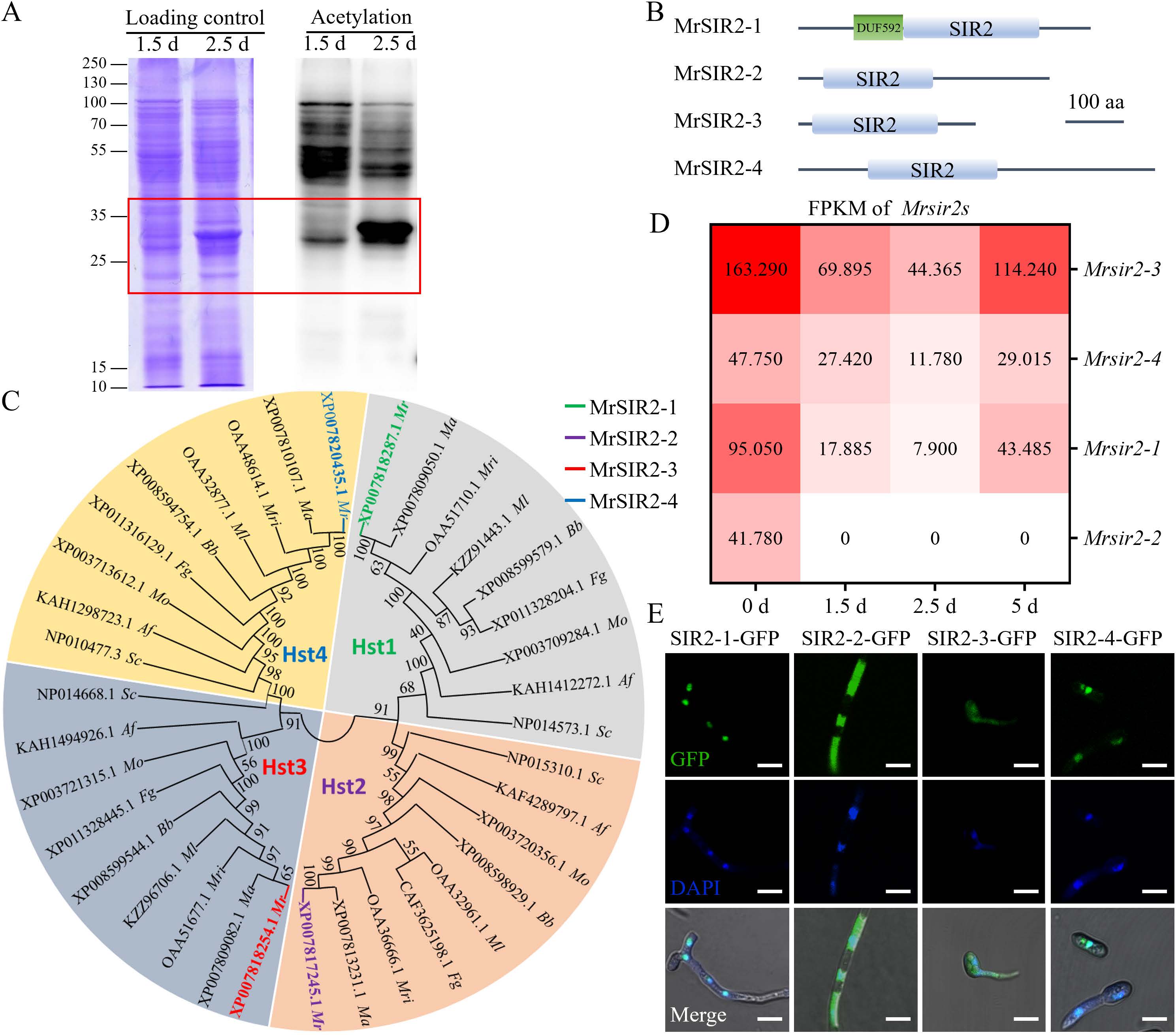
Fig 1. Acetylation and SIR2 proteins in M. robertsii. (A) Immunoblot analysis was performed to assess lysine acylation in mycelial growth and the initial conidiation stages. Coomassie blue staining of the gel served as the loading control, with 20 μg of protein loaded in each lane. (B) Schematic representation illustrating four M. robertsii SIR2 proteins. DUF592, unknown function domain of the protein; SIR2, silent information regulator 2; aa, amino acids. (C) Alignment of M. robertsii and other fungal SIR2 proteins. Protein sequences were aligned, and the phylogenetic tree was generated using MEGA11. Mr: M. robertsii; Ma: M. acridum; Mri: M. rileyi; Ml: Moelleriella libera; Bb: Beauveria bassiana; Fg: Fusarium graminearum; Mo: Magnaporthe oryzae; Af: Aspergillus fumigatus; Sc: Saccharomyces cerevisiae. (D) Quantification of Mrsir2 genes expression in M. robertsii using RNA-seq at different developmental stages. (E) Subcellular localization of MrSIR2 proteins. Scale bar = 5 μm.