Taxonomy
Tolypocladium dujiaolongae Y.P. Cao & C.R. Li, sp. nov.
Figs 3, 4MycoBank MB821894
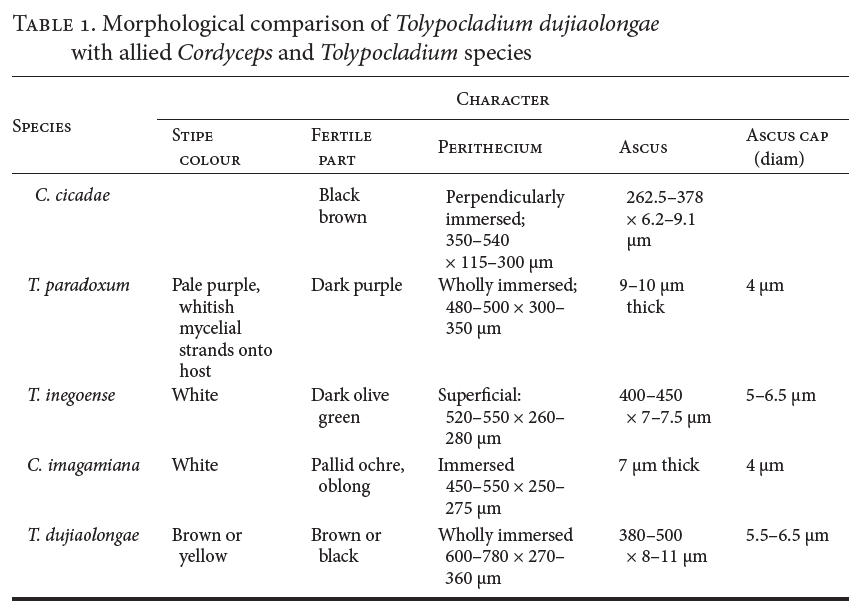
Differs from Cordyceps cicadae S.Z. Shing by its larger perithecia and larger asci; and from C. imagamiana, Tolypocladium inegoense, and T. paradoxum by its blackish-brown to blackish-purple stipe, its brown to black fertile parts, its larger perithecia, and stipe with or without rhizoids attached to the host.
Type: China. Anhui Province: Qimen County, National Natural Reserve of Guniujiang, 30°01′N 117°31′E, alt. 420 m, 16.VI.2013, Y.P. Cao GNJ130616-01 (Holotype, ZBAH632; GenBank KF696557; ex-ascospore culture, RCEF6201, GenBank KF696558).
Etymology: dujiaolongae refers to the traditional Chinese name for the species, which translates as “single-horned dragon”.
Stroma arising from the head of the nymphal cicada host, blackish brown to blackish-purple, fleshy, mostly solitary, occasionally branched, erect or curving, 26–70 (rarely 105) mm long, clavate or obclavate, corniform or oblate,with a blunt or slightly apiculate and tuberculate tip and sunken grooves.Stipe cylindric, 5–10 mm thick, 10–45 mm long, brown or yellow. Fertile part clavate, 40–55 × 4–12 mm, clearly defined from the stipe, punctate with perithecial ostioles, brown to black, without sterile tip. Perithecia ampullaceous, wholly immersed, (233–)520–740(–780) × (250–)300–330 (–360) μm, with wall 23.0–33.5 μm thick and ostioles 34–80 μm in diameter.Asci 8-spored, hyaline, cylindrical, (380–)420–468(–500) × 8–11 μm. Ascus cap hemispherical, 5.5–9.0 μm in diameter, 4.0–8.0 μm high. ascospores hyaline, filiform, 240–310 μm long when discharged, smooth, multiseptate,breaking into cylindrical part spores, 3–5(–7.0) × 2–3 μm, germinating at 25°C on PDA.
Colonies growing slowly, 10–15 mm in diameter after 7 days on Czapek-Dox agar at 25°C; velutinous, loose, white to yellowish, hemispherical with a 2–3 mm high region protruding in the colony centre. Reverse white. Colonies on PDA growing moderately at 25°C after 7 days, 16.0–18.0 mm diam., and 28–30 mm after 14 days on PDA, velutinous, loose, white. Reverse centre yellow-orange to dark brownish, with white margin. Hyphae septate, smoothwalled,hyaline, 2.0–3.5 μm wide. Phialides solitary, occasionally verticillate, (5–)11–35(-52) × 1.0–2.7 μm, usually growing on the aerial mycelium or on simple conidiophores, cylindrical or conical, slightly swollen basally, narrowly tapering into a distinct neck approximately 1.0 μm wide, terminal phialides generally elongate; neck often bent without clear denticulate scars. Conidia one-celled, hyaline, smooth-walled, globose to ovoid when separate, and polyhedral when aggregated, (2.5-)3–4(–4.7) × 2.4–3.7 μm, aggregating mostly in small heads, 11.0–36.8 μm in diameter and occasionally in chains at the tips of the phialides; a very small proportion of the conidia much larger, long ellipsoidal, approximately 5–9 μm wide and up to 8–25(–36) μm long.
Ecology & distribution—Scattered in bamboo forest. Summer. Common in southern China, especially in Zhejiang, Anhui, Jiangsu, Jiangxi, and Fujian provinces.
Additional specimen examined — China. Anhui Province: Qimen County, National Natural Reserve of Guniujiang, 30°01′N 117°31′E, alt. 420 m, 16.VI.2013, Y.P. Cao GNJ130617-02 (ZBAH633; ex-ascospore culture RCEF6202).
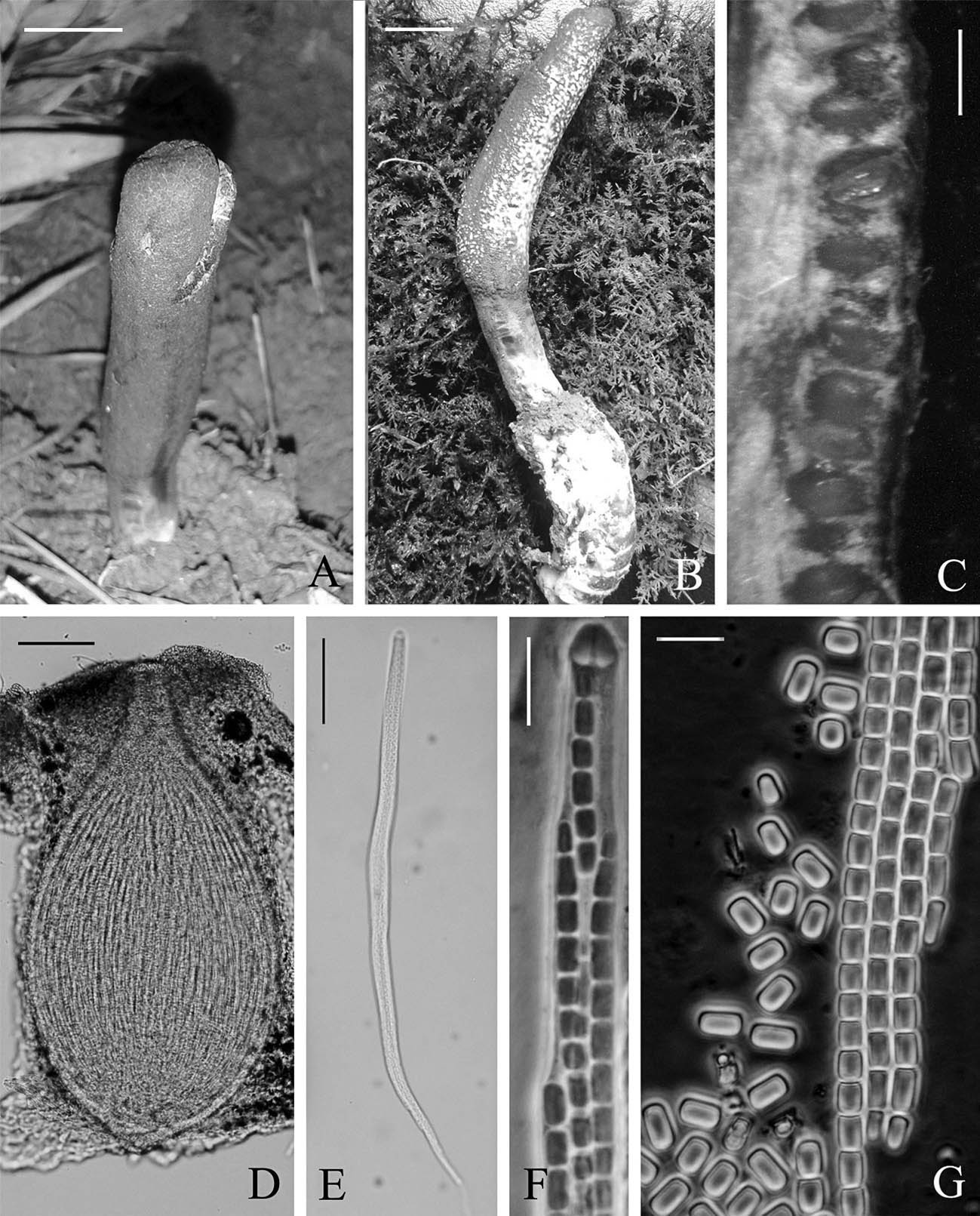
Fig. 3 Tolypocladium dujiaolongae teleomorph.
A, B: Stroma of Tolypocladium dujiaolongae;
C: Wholly immersed perithecia;
D: Perithecium; E: Whole ascus;
F: Upper part of ascus;
G: Part spores.
Scale bars: A, B = 10 mm; C = 500 μm; D = 100 μm; E = 50 μm; F, G = 10 μm.
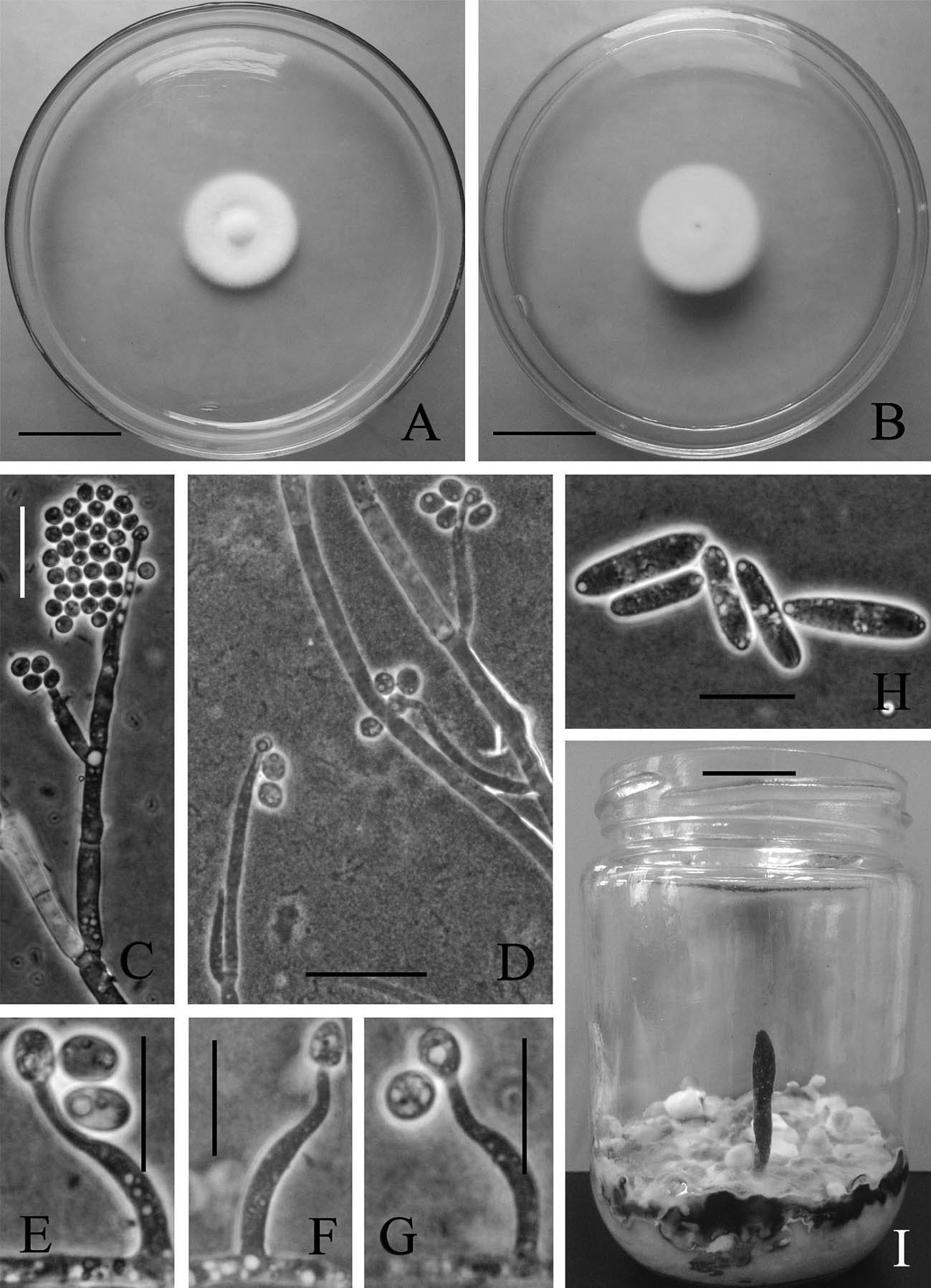
Fig. 4 Tolypocladium dujiaolongae anamorph.
A: Colony on PDA (25°C, 14 d);
B: Colony, reverse side;
C–H: Conidiophores and conidia;
I: Stroma of Tolypocladium dujiaolongae on artificial media.
Scale bars: A, B = 2 cm; C–H = 10 μm; I = 20 mm.
Discussion
Taxonomy and phylogeny
The macroscopic and microscopic characteristics of T. dujiaolongae specimens collected from the Guniujiang Nature Preserve were nearly identical to those described as C. cicadae by Shing (1975), especially with regards to the shape and size of the part spores but with exceptions for the larger perithecia and longer asci (Table 1). The teleomorphs of T. paradoxum, Tolypocladium inegoense (Kobayasi) C.A. Quandt & al., and C. imagamiana were compared with Tolypocladium dujiaolongae (Table 1, Fig. 2). These are all parasitic on cicada nymphs and produce cylindrical part spores. Although the ITS sequences were similar there are obvious differences between T. paradoxum and T. dujiaolongae in the appearance of their stromata. Those of T. paradoxum are pale purple and attached to the host by subterranean whitish rhizoids (Shimizu 1997, Plate 24). In comparison, the stroma of T. dujiaolongae is brown or yellow and simple attached directly to the host without rhizoids.
Tolypocladium inegoense is easily distinguished from T. dujiaolongae by the superficial (but crowded) nature of its perithecia compared with the immersed form of T. dujiaolongae and the colour of its fertile part which is a dark olive green compared with the blackish brown of T. dujiaolongae (Shimizu 1997 Plate 14). According to the description and the picture of C. imagamiana (Kobayasi & Shimizu 1983; Shimizu 1997 Plate 23),T. dujiaolongae and C. imagamiana are also quite different in the appearance of their stromata. The latter have longer stromata (90 mm) and a thinner stipe (1.5–2.0 mm) with a pallid ochre and oblong fertile part. We have no further information regarding the specimen identified as C. imagamiana from China and consider this named to have been misapplied.
The morphological features of the cultured anamorph of T. dujiaolongae are also consistent with the genus Tolypocladium. Four species in this genus (T. inflatum W. Gams, T. cylindrosporum W. Gams, T. geodes W. Gams, and T. tundrense Bissett) are similar to the anamorph of T. dujiaolongae. The conidiogenous cells of T. dujiaolongae are similar in shape and size to those of T. geodes, but this species differs in only having one type of conidia, either subglobose or broadly obovoid, and some of its strains on Czapek- Dox’s agar are dark green or bluish (Gams 1971). Tolypocladium inflatum and T. cylindrosporum not only have one type of conidia like T. geodes, but the conidiogenous cells of both species are ellipsoidal to subglobose at the lower part. In contrast, those of the cultured anamorph of T. dujiaolongae are cylindrical or only slightly swollen basally (Gams 1971). Tolypocladium tundrense resembles the anamorph of T. dujiaolongae in producing two types of conidia, but their conidial size and shape are different (Bissett 1983). Furthermore, these four species exhibit solitary and verticillate phialides (Table 1).
Gams (1971) established the genus Tolypocladium with the type species T. inflatum, and described three soil-inhabiting species, T. inflatum, T. cylindrosporum and T. geodes. Since then many species have been described in the genus. However, most Tolypocladium species have been described from soil samples and as a result their true role in the soil remains largely unknown. Although well known as saprobes commonly found in the soil, many Tolypocladium species are also entomopathogenic fungal parasites on a range of insects, rotifers, nematodes, and other fungi. Hodge & al. (1996) first established the relationship between Tolypocladium and Cordyceps sensu lato demonstrating that Cordyceps subsessilis Petch has a Tolypocladium anamorph.
Sung & al. (2007) recognised Tolypocladium and Tolypocladiumproducing teleomorphs in the newly erected family Ophiocordycipitaceae (Hypocreales). Species were placed in the “C. ophioglossoides clade” and a new genus, Elaphocordyceps G.H. Sung & Spatafora, was erected to accommodate these taxa (Sung & al. 2007). However, following the 2011 Nomenclature Session of the XVIII International Botanical Congress in Melbourne, a single system of nomenclature, or “one fungus = one name” (1F = 1N), became effective 1 January 2013, regardless of life history states. In order to reflect changes in Article 59 of the ICN, Quandt & al. (2014) emended the family Ophiocordycipitaceae based on molecular phylogenetic analyses and proposed six genera encompassing Drechmeria, Harposporium, Ophiocordyceps, Polycephalomyces, Purpureocillium, and Tolypocladium; Elaphocordyceps is no longer a valid name in the 1F = 1N framework, and species were transferred to the genus Tolypocladium.
As with I. cicadae it would appear that T. dujiaolongae has probably also had a long history of usage in TCM under the general name of ‘cicada flower’. We have found no documented records of human consumption of T. dujiaolongae causing problems. Studies on the effects of artificial culture conditions on the artificial fruit body formation of T. dujiaolongae, submerged fermentation of strains, and detection of myriocin and other metabolites are ongoing by our team.
Acknowledgments
The authors thank Drs G.H. Sung, C.L. Hou, and B. Shrestha for reviewing and improving the manuscript. We especially thank the late Dr Walter Gams for his discussions on adopting the word “cordycipoid” to describe taxa in Clavicipitaceae, Cordycipitaceae, and Ophiocordycipitaceae. This work was supported by the National High Technology Research and Development Program of China (863 Program,No. 2007AA021506) and the National Natural Science Foundation of China (No. 30570004).
Literature cited
Bissett J. 1983. Notes on Tolypocladium and related genera. Canadian Journal of Botany 61:1311–1329. https://doi.org/10.1139/b83-139
Gams W. 1971. Tolypocladium, eine Hyphomycetengattung mit geschwollenen Phialiden. Persoonia 6: 185–191.
Hall TA. 1999. BioEdit: a user-friendly biological sequence alignment editor and analysis program for Windows 95/98/NT. Nucleic Acids Symposium Series 41: 95–98.
Hodge KT, Krasnoff SB, Humber RA. 1996. Tolypocladium inflatum is the anamorph of Cordyceps subsessilis. Mycologia 88: 715–719. https://doi.org/10.2307/3760965
Kobayasi Y. 1939. On the genus Cordyceps and its allies on cicadae from Japan. Bulletin of the Biogeographical Society of Japan 9: 145–176.
Kobayasi Y. 1941. The genus Cordyceps and its allies. Science Reports of the Tokyo Bunrika Daigaku, Section B, 5: 53–260.
Kobayasi Y, Shimizu D. 1983. Cordyceps species from Japan 6. Bulletin of the National Science Museum, Tokyo, series B, 9: 1–21.
Li ZZ, Li CR, Huang B, Fan MZ, Lee MW. 1999. New variety of Cordyceps gunnii (Berk.) Berk. and its Paecilomyces anamorph. Korean Journal of Mycology 27: 231–233.
Mains E. 1958. North American entomogenous species of Cordyceps. Mycologia 50: 169–222.https://doi.org/10.2307/3756193
Massee G. 1895. A revision of the genus Cordyceps. Annals of Botany 9: 1–44.https://doi.org/10.1093/oxfordjournals.aob.a090724
Miquel FAW. 1838. Sur une espèce nouvelle d’Isaria, du Brésil. Bulletin des Sciences Physiques et Naturelles en Néerlande 36: 85–86.
Petch T. 1924. Studies in entomogenous fungi: IV. Some Ceylon Cordyceps. Transactions of the
British Mycological Society 10: 28–45. https://doi.org/10.1016/S0007- 1536(24)80005-0
Petch T. 1931. Notes on entomogenous fungi. Transactions of the British Mycological Society 16:55–75. https://doi.org/10.1016/S0007-1536(31)80006-3
Petch T. 1933. Notes on entomogenous fungi. Transactions of the British Mycological Society 18:48–75. https://doi.org/10.1016/S0007-1536(33)80026-X
Petch T. 1935. Notes on entomogenous fungi. Transactions of the British Mycological Society 19:161–194. https://doi.org/10.1016/S0007-1536(35)80008-9
Petch T. 1942. Notes on entomogenous fungi. Transactions of the British Mycological Society 25:250–265. https://doi.org/10.1016/S0007-1536(42)80017-0
Quandt CA, Kepler RM, Gams W, Araújo JPM, Ban S, Evans HC, Hughes D, Humber R,Hywel-Jones N, Li Z, Luangsa-ard JJ, Rehner SA, Sanjuan T, Sato H, Shrestha B, Sung G-H, Yao Y-J, Zare R, Spatafora JW. 2014. Phylogenetic-based nomenclatural proposals for Ophiocordycipitaceae (Hypocreales) with new combinations in Tolypocladium. IMA Fungus 5: 121–134. https://doi.org/10.5598/imafungus.2014.05.01.12
Shimizu D. 1997. Illustrated Vegetable Wasps and Plant Worms in Colour. Tokyo, Ie-no-hikari Association.
Shing SZ. 1975. Classification of Cordyceps sobolifera (Hill) Berk. et Br. and Cordyceps cicadae Shing sp. nov. (in Chinese). Acta Microbiologica Sinica 15: 21–26.
Sung GH, Hywel-Jones NL, Sung JM, Luangsa-ard JJ, Shrestha B, Spatafora JW. 2007. Phylogenetic classification of Cordyceps and the clavicipitaceous fungi. Studies in Mycology 57: 5–59. https://doi.org/10.3114/sim.2007.57.01
Watson W. 1763. An account of the insect called the Vegetable Fly. Philosophical Transactions of the Royal Society 53: 271–274. https://doi.org/10.1098/rstl.1763.0045
Zhu H, Qu F, Zhu LH. 1994. Isolation of genomic DNAs from fungi using benzyl chloride (in Chinese). Acta Mycologica Sinica 13: 34–40.