Tolypocladium dujiaolongae sp. nov. and its allies
Chunru Li1, 2, Nigel Hywel-Jones1,Yupeng Cao2, Sunghee Nam3, Zengzhi Li2*
1 Zhejiang BioAsia Institute of Life Sciences, Pinghu, Zhejiang, China
2 Anhui Provincial Key Laboratory for Microbial Control, Anhui Agricultural University,Hefei 230036 China
3 National Institutes of Agricultural Science & Technology, Department of Agricultural Biology, R.D.A. Suwon, Korea
* Correspondence to: zzl@bioasia.com.cn
Abstract—A common cicada pathogen occurring in bamboo forests of southern China is described as a new species, Tolypocladium dujiaolongae. The previously unknown anamorphic state was obtained from discharged ascospores. Based on its morphological characteristics and a molecular analysis of the internal transcribed spacer rDNA sequence, we found that the asexual features of T. dujiaolongae are similar to those of Tolypocladium species. The typical characteristics of the fungus are described. The fruiting bodies formed on artificial culture media were identical to those of natural specimens, strongly supporting the idea that the isolated strain is the asexual stage of T. dujiaolongae. Our results indicate that there is no relationship between Tolypocladium dujiaolongae and the famous traditional Chinese medicine Isaria cicadae.
Key words—anamorphic–teleomorphic connection, morphology, phylogeny, mycoparasite,taxonomy
Introduction
The use of cordycipoid pathogens of cicadas in Traditional Chinese Medicine (TCM) has a longer documented history (>1500 years) than the TCM usage of Ophiocordyceps sinensis (Berk.) G.H. Sung & al. (c. 500 years). The adjective“cordycipoid” refers to all taxa in the families Clavicipitaceae, Cordycipitaceae, and Ophiocordycipitaceae. Use of the cicada pathogen can be traced to a 5th century medical work by Leixiao, titled “Lei’s Treatise on Preparing Drugs”(雷公炮炙论), which recorded the preparation of a cicada pathogen, referred to as “cicada flower” (Chan-hua 蝉花) for medical use against childhood disorders. This “cicada flower” has generally been identified as Isaria cicadae Miq. (Fig. 1). In the market a small proportion of specimens appear more robust leading to the Chinese folk recognition of a “male (robust) cicada flower” as compared to the “female cicada flower” with its slender synnemata. In southern China, the “male” form is more often called the “single horned dragon” (Dujiaolong, 独角龙) due to its solitary robust stroma.
Shing (1975) reviewed these wild collections and recognised the “male cicada flower” as the teleomorph, which he mistakenly associated with I. cicadae. As well as making this link he also distinguished between Isaria cicadae and Cordyceps sobolifera (Hill ex Watson) Berk. & Broome, which is also sold and named as “cicada flower” in some areas in southern China.
Approximately 30 species of Cordyceps sensu lato and related genera are known to be pathogens of cicadas. Of these, C. sobolifera, I. cicadae, and Cordyceps cicadae (Miq.) Massee, are three New World names that have been widely used in the Old World (especially east Asia) without real reference, or comparison, to the type materials. Following the work of Sung & al. (2007), C. sobolifera was transferred to the genus Ophiocordyceps in the newly created family Ophiocordycipitaceae. The latter two taxa retained the same names within the family Cordycipitaceae. Historically, Ophiocordyceps sobolifera was the earliest named cordycipoid cicada pathogen (CCP), based on material from Guadeloupe and other islands of the Caribbean (Watson 1763). Isaria cicadae was later described by Miquel (1838) from a cicada in Brazil. The name Cordyceps cicadae was proposed for Miquel’s taxon by Massee (1895) on the assumption that the Isaria was the ‘imperfect’ form of an unknown Cordyceps; however, no teleomorphic Cordyceps state has yet been described for a South American I. cicadae.
Throughout the twentieth century these three names were frequently applied to east Asian taxa of CCPs: with many collections from China, Japan, Korea, and Thailand, as well as New Zealand. Petch (1924, 1931, 1933, 1935, 1942) reviewed these names, as did Kobayasi (1939, 1941). Although Petch (1933) did not link I. cicadae and C. sobolifera in a list of synonyms, he later (Petch1935, 1942) accepted I. cicadae as the anamorph of C. sobolifera. This link was also accepted by Mains (1958). Significantly, while Petch and Mains were not familiar with these fungi in the field, Kobayasi (1941) demonstrated that I. cicadae and C. sobolifera (as understood from Asian material) were unrelated.
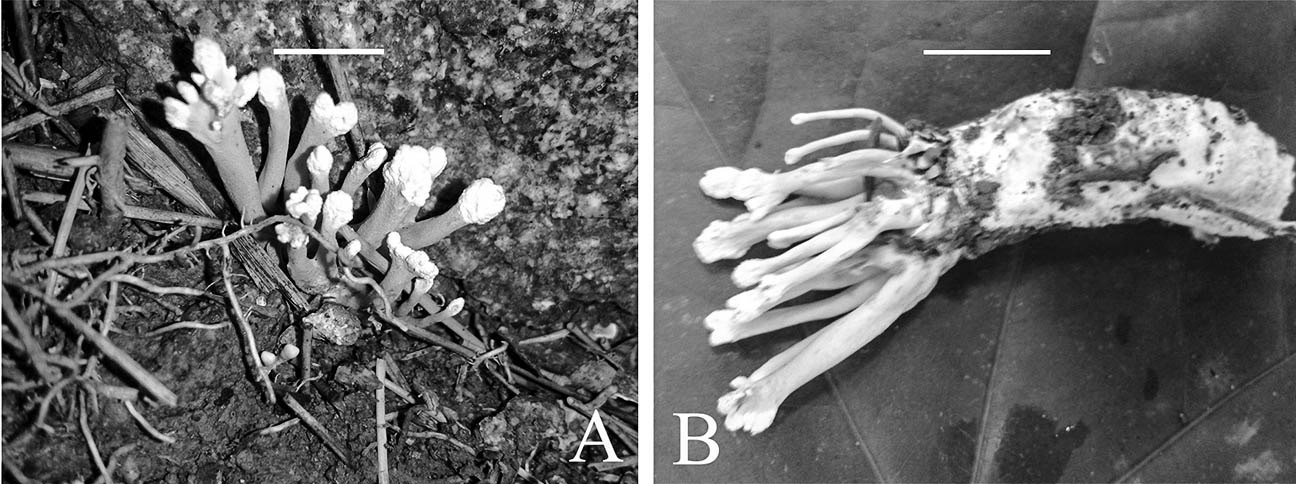
Fig. 1 Chan-hua (Isaria cicadae).A: Emergent synnemata.
B: Excavated Chan-hua. Scale bars = 10 mm.
In China, Shing (1975) recognised C. sobolifera and I. cicadae as distinct species based on Chinese collections of the two taxa although he accepted that the Asian C. sobolifera had an Isaria anamorph. Seemingly unaware of the Massee (1895) combination for the South American material, Shing (1975) further described a Cordyceps teleomorph that he associated with the Asian I. cicadae, and named this Cordyceps cicadae S.Z. Shing (an illegitimate later homonym of the Massee name). This anamorph–teleomorph link was based on the temporal and spatial co-occurrence of the two taxa in bamboo forest habitats in southern China and the proximity of the teleomorph specimens to collections of I. cicadae and to their being sold together in markets.
In 2012 and 2013, we collected specimens of CCPs from the Guniujiang Nature Preserve (Anhui Province, southeastern China). This is an area where medicinally valuable cicada ‘cordyceps’ have traditionally been collected. Our anamorph collections matched the Asian concept of I. cicadae, while our teleomorph specimens matched Shing’s C. cicadae. However, isolates derived from ascospores produced an anamorph in culture that was not an Isaria (as had been concluded by Shing 1975). Rather, it belonged to the genus Tolypocladium based on morphological characteristics and a comparison of its 5.8S rDNA and ITS sequences. This Tolypocladium species is described here.
Materials & methods
Specimens and fungal isolates
Twenty-one specimens of CCPs were collected in bamboo forest from the Guniujiang Nature Preserve (Qimen County, southern Anhui, China, 30°01′N117°31′E) at an elevation of approximately 420 metres above mean sea level. The specimens’ hosts were soil-dwelling nymphs of an unidentified cicada. Isolates were derived from ascospores discharged onto glass slides according to the method of Li & al. (1999), RCEF6201 from GNJ130616-01 (= ZBAH632) and RCEF6202 from GNJ130617-02 (= ZBAH633). Many specimens of I. cicadae were also collected and isolated. One isolate of I. cicadae (RCEF0817-13) was further used in this study.
All specimens were freeze-dried and stored at 4°C after isolation and description as preparation for DNA extraction. The morphological characteristics of cultures incubated on potato dextrose agar (PDA) and Czapek-Dox agar at 25°C for 7 and 14 days were recorded. Specimen vouchers were conserved in the herbarium of Zhejiang BioAsia Pharmaceutical Co, Ltd., Zhejiang, China (ZBAH); and strains were conserved in the culture collection of Research Center on Entomogenous Fungi, Hefei, China (RCEF).
DNA extraction, PCR, and sequencing
Fresh mycelium (RCEF6201 and RCEF0817-13) was obtained from the surface of PDA plates that had been incubated at 25°C for 14 days. Approximately 0.1 g of sample was ground under liquid nitrogen in 1.5 ml Eppendorf tubes, and genomic DNA extracted using benzyl chloride according to a modification of the method described by Zhu & al. (1994).
The PCR mixtures, totalling 25 μL, were composed of 2.5 μL of 10 × Buffer (10 mM Tris/HCI, pH 8.3), 0.5 μL of a mixture containing 10 mM each of the four deoxyribonucleotide triphosphates (dNTP), 1.0 μL of each primer at 10 μmol/L (ITS4:5′-tcctccgcttattgatatgc-3′ and ITS5: 5′-ggaagtaaaagtcgtaacaagg-3′, Sango Biotech Co., Ltd., Shanghai), 0.2 μL of 5 U/μL DreamTaq polymerase (Fermentas, Thermo Scientific), 1 μL of template DNA, and 18.8 μL of doubledistilled water.
The PCR was performed under the following temperature profile: 95°C for 5 min, followed by 37 cycles of 95°C for 30 s, 56°C for 30 s, and 72°C for 50 s, and a final extension at 72°C for 10 min. The PCR products were detected on an ethidium bromide (EB) gel (1.0% agarose gel including 0.5 g/ml EB).
The purification of the resulting products, as well as the sequencing of forward and reverse strands, was performed at the Beijing Genomics Institute (BGI). The sequencing data for the Anhui CCP (teleomorph and anamorph) and I. cicadae were submitted to GenBank.
Alignments and analysis
ITS1-5.8S-ITS2 sequences and those that we downloaded from GenBank were imported into the programme BioEdit Sequence Alignment Editor Version 4.8.6., aligned using Clustal X 2.0 for multiple sequence alignment and corrected manually (Hall 1999). The phylogenetic tree was constructed by the Neighbor-joining method (NJ) of MEGA 4.0 with 1000 bootstrap replicates. Beauveria bassiana (AF347611) was used as an outgroup taxon in the analyses. Bootstrap support of ≥70% was superimposed on all tree constructions.
Results
Molecular results
The ITS1-5.8S-ITS2 region of I. cicadae (GenBank KF740422) comprised 498 bp and showed a similarity of only 75.6% with the Anhui CCP. Both PCR products of the field-collected teleomorph and the culture of the Anhui CCP were detected by agarose gel electrophoresis. The amplified fragments spanning the ITS1-5.8S-ITS2 of the teleomorphic field material (GenBank KF696557) and the anamorphic culture (GenBank KF696558) were the same size (485 bp).The sizes of ITS1 (165 bp), 5.8S rDNA (146 bp), and ITS2 (174 bp) regions were also identical. This evidence confirmed that the isolate RCEF6201 was the anamorph of the field material ZBAH632, and not the Isaria anamorph of C. cicadae as concluded by Shing (1975).
To determine the phylogenetic position of the Anhui CCP, the sequences of the field material and the ex-ascospore strain RCEF6201 were compared with available sequences in GenBank via a BLAST search. These sequences revealed the Anhui CCP to be linked with the genus Tolypocladium (Fig. 2) and not with Cordyceps cicadae / Isaria cicadae as described by Shing (1975). However, the sequences and morphologies of the Anhui CCP and its cultured anamorph differed from those of other Tolypocladium spp.
Our study of the Anhui CCP revealed a new clade and suggested that it is a distinct taxon in Tolypocladium based on the molecular and morphological information. The teleomorph and culture of the CCP clustered in one group strongly supported by bootstrap proportions (BP = 100%). A sister-group relationship between Tolypocladium paradoxum (Kobayasi) C.A. Quandt & al.and the Anhui CCP was also strongly supported (BP = 100%) (Fig. 2).
BLAST searches in GenBank suggested that there are several Tolypocladium species similar to the Anhui CCP. The Anhui CCP shared 98.1% homology with T. paradoxum (AB027369), which is also pathogenic on cicada nymphs, and 94.9% with Tolypocladium ophioglossoides (J.F. Gmel.) C.A. Quandt & al.(AJ309360), which is pathogenic on Elaphomyces. It also shared a high level of ITS sequence identity with a sequence from China identified as Cordyceps imagamiana Kobayasi & Shimizu. Although there was little molecular divergence between the Anhui CCP and C. imagamiana, the morphological differences between the Anhui CCP and the original Japanese description of C. imagamiana were noticeable (Kobayasi & Shimizu 1983, Shimizu 1997 Plate 23). On the basis of these results we describe the Anhui CCP as a new species of Tolypocladium (sensu Quandt & al. 2014) in accordance with the one fungus = one name (1F = 1N) principle.
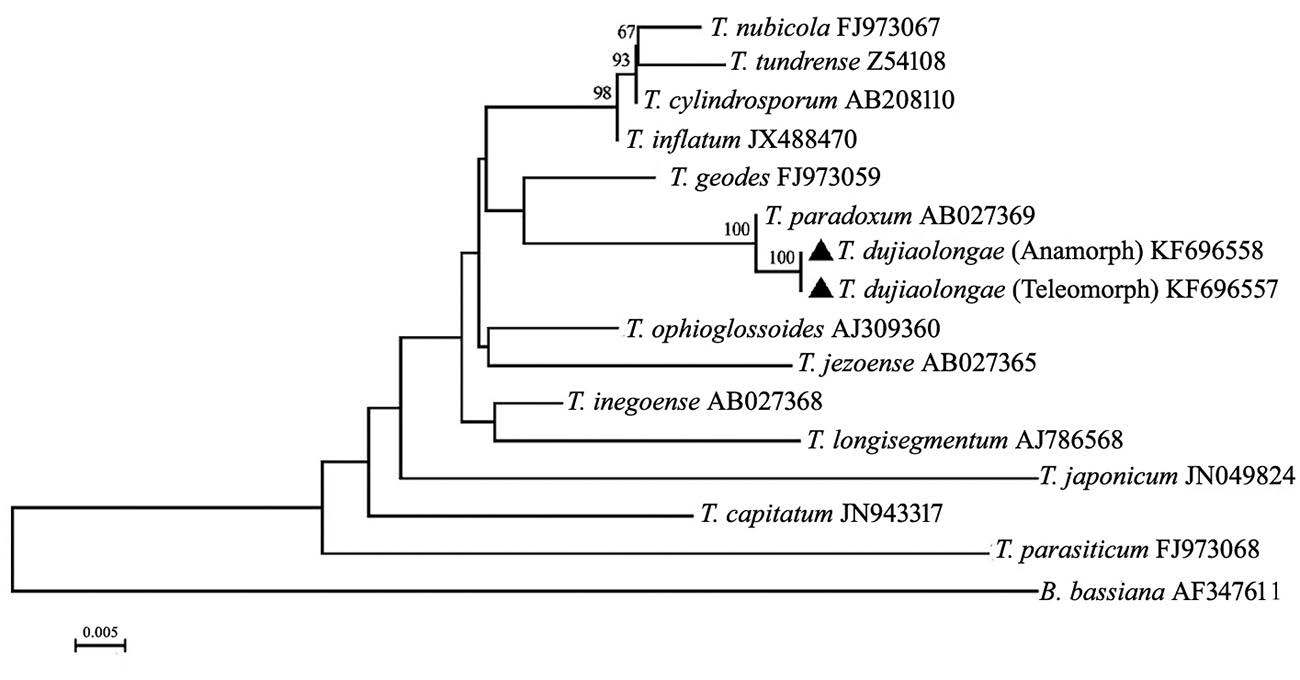
Fig. 2 Neighbor-joining tree based on ITS1-5.8S-ITS2 region sequence data from Tolypocladium dujiaolongae and related species. Values above the branches indicate bootstrap support.